Sunday, August 7, 2011

Post # 7 - From Sitka, Alaska, Sunday August 7, 2011

Entry # 7:  Begin at Bartlett Cove  (Glacier Bay), on July 29, 2011

Hardly had we bid farewell to our children and grandchildren when Joel Tranum arrived (same plane), to join us on the ride to Sitka.  We had a great Dungeness crab dinner at the Glacier Bay Lodge, and in the a.m. headed off to do some reprovisioning in Gustavus.  Joel and I headed to Pep’s Packing, a place where the sportfisherman bring their catches to be frozen and packed for the ride home to wherever.  It is also the place which has won the most prizes in Alaska for its smoked salmon and halibut, and that is what we were after.  Pep’s is about ½ mile down a dirt road off the main drag through town, but we found it o.k, and loaded up.  Then we hiked back out, flagged down the lodge van going by, picked up Pam at the grocery and headed back to the boat.  By now the lousy weather had become bright sunlight with some lingering low fog which gradually dissipated.  Bummer for the kids!


Our destination for the day was Dundas Bay, which is still part of the Glacier Bay National Park, but out of the restricted area.  Along the way I tried to fish again, based on the advice from the folks at the Bartlett Cove dock.  No luck, so we wound up deep into the reaches of Dundas Bay very much alone, looking up at Mt. Fairweather and its range.  The water temperature was a balmy 52 degrees, so Joel insisted on going in to prove a point.  Hot showers felt very good thereafter!
Dundas Back Anchorage - Mt. Fairweather


In the morning the weather had shut down again, as we headed South across Cross Sound at the entrance to the Pacific Ocean, to tiny Elfin Cove.  A cruise ship went by us close in the fog, and JACA rolled heavily in the oily calm ocean swells.  Elfin Cove is a reminder of what many South Coast Newfoundland communities might have been like, had the fishing remained in some form.  Totally disconnected by land, this small community (17 permanent residents last winter) comes alive in the summer with an influx of sport fisherman to the 8 or so small lodges that cater exclusively to them.  Perhaps 150 or so folks are there at any moment, fishing from small boats owned by the lodges, as well as a small fleet of commercial fisherman who unload their catches daily onto a waiting collector boat.  There are no roads and no motorized vehicles at all: only wooden walkways clinging to the steep walls of the forest and small structures clustered around.  You can walk around the whole place in 15 minutes.
We tied up to the “free” transient dock, a sturdy facility at the outer end of the town, next to the seaplane float.  A new feature at the dock is 30 amp power, so we tracked down the operator of the Elfin Cove Power Company, working on the roaring generators that do the job.  No problem – we were hooked up in no time, with a steep hookup charge.  The planes bring and take away a steady stream of clients for the lodges, generally coming from Juneau.  I wandered around looking for someone to take me out in a small boat for a couple of hours to learn how to catch a salmon.  Dennis appeared, and the three of us hopped in.  Within two hours we’d caught two “pink” salmon that Dennis deemed unworthy and threw back, a small bass that also went back, and two nice big Coho salmon for the fridge.  I got my fishing lesson; Pam got a filleting lesson, and we were happy campers.  No wonder folks come from all over to do this!

Downtown Elfin Cove


Elfin Cove Public Dock
We stayed the night in Elfin, and spent a good deal of time talking to a variety of people, all of whom had differing points of view about what the place was all about, had, been and should be.  Some of the “locals” decried the burgeoning fishing lodge business.  Virtually all lodges are owned by people “from away”, who come in the spring and disappear in September.  Since all the floats are built, paid for and owned by the State, the community has no power over them.  The lodges get free use of them for their numerous day fishing boats.  Because the place is not a legal entity, no-one pays any real estate taxes.  Not a bad deal for a lodge owner.  But the community owns the tiny power company (all housed in a building the size of JACA’s cabin), and it can and does charge a lot for the power.  From an outsider’s point of view, it is the lodges that are keeping this community alive and, on the surface at least, prospering at some level.  But no one denies that there are many fewer fish out there than there used to be.  Who knows what this will look like 50 years from now.
From Elfin Cove we headed down the Lisianski Inlet, which is an inland shortcut to the first part of the “outside” ride to Sitka, on the western side of Baranoff Island.  About 12 miles down the inlet is another tiny village, Pelican, which, like Elfin Cove, is a totally isolated boardwalk community snuggled into the encircling mountains.  Until two years ago, however, there was a fish packing plant here that employed 100 people, so Pelican on the surface is a somewhat larger establishment.  It boasts the status of a legal town, complete with a tiny town hall and a mayor.  The packing plant, owned by a Native American investment company, has closed.  So now much of residential Pelican is for sale, and the place is struggling to find its own direction.  The boardwalk, water, power and float infrastructure is amazing and extensive, but right now only about 70 residents are here. Except for a couple of small fishing lodges, and a reasonably good fishing season for the few local commercial fisherman, the largest current employer is the school system, which exists for a total of 12 kids.  Intrigue abounds among the locals.  It didn’t take long to hear stories ranging from the imminent reopening of the plant to the plot of the investment company to turn the entire town into a resort for the tribe that owns the facility, evicting everyone else along the way.  As everywhere in Alaska, all this happens in a dramatic, spectacular setting.


Downtown Pelican

We left Pelican early morning to catch the slack ebb out of the Lisianski Strait into the Pacific Ocean.  Otherwise it can be pretty wild, and in the fog and rain we weren’t anxious for that.  All went well, we threaded our way through the rocks in the “inside passage” and finally were out in the Pacific swell for about 15 miles, headed to Goulding Harbor, a “must see” on Frank Kibbe’s list.  It was nice to feel a rolling platform under my feet again.  Some whales and multitudes of sea otters around us – one mom and her pup were as inquisitive about us as we were about her – see the picture!


Frank had told me to anchor in the “second pool”, which looked o.k. on the chart, except that there was a large rock at the entrance.  We worked our way in, slowly, trying to avoid the rock which was visible at half-tide, and when the depth got to 1’ beneath the keel I went fast reverse.  Eventually, after poking and pushing around a little, we made it into the pool and settled down in about 30’ of water.  It is a gorgeous place, typical of the West coast of Baranof Island.  A dinghy ride up into the third pool, where the big salmon stream flows out, resulted in a great bear sighting: a large juvenile grizzly was feeding on a grassy island at the head of the island.  He heard us, then about 100 feet away, stood up on his hind legs to see us, watched us for a while, and then went back to eating.  Ultimately he swam to the nearby shore, while we headed up the river as far as we could go in the dinghy.  Salmon were jumping all over the place, and when we got to a point we could go no further, there were hundreds of them swimming around and underneath us, waiting to proceed up the rocks in the stream.  An amazing sight!
I was concerned about getting out of the pool in the morning around the rocks in a much lower tide, so we went out to the first pool and anchored in a lovely small cove by a gurgling outflowing stream.  More swimming.  Then I read Frank Kibbe’s diary from the year before:  he’d hit the rocks that we’d so nearly avoided.  We laughed about it on the sat phone the next day, and all he could say was “Oh shit. I told you the wrong pool!”  Next time he’s here he’ll have the map. 
Frank also recommended another salmon stream in Lake Anna, a few miles down the coast, so we headed there also.  On a rising tide, we dinghied up to the head of the stream, close to the outlet, where there was a short waterfall with lots of water cascading over it.  In the water we could see literally hundreds of salmon massing in front of the falls.  As the tide came up so the fall was a little shorter, the salmon started to throw themselves up, trying to get to the small pool above.  Most came tumbling back down, but a few made it to the first small pool.  Trouble was, it was even worse going for them to the next area, and we could see a few of them struggle onward, in their inexorable drive to return to whence they came, spawn and die.  It is an extraordinary sight – what is it that drives them?  What is it that drives us?

One falling back - unsuccessful jump!

Eagle waiting to pounce on Salmon


Salmon massing to jump up falls
To avoid a big tide rip in the morning, we slipped out of Lake Anna at slack tide, and wound up in Double Cove for the night.  It reminded me of finding Duck Harbor on Isle Au Haut in the fog: a rocky coast in a rolling sea, and you don’t see the entrance until it is almost too late.  But it was calm and peaceful in there on a rainy night.  The forecast for the next day had been consistently bad: small craft warnings, rain etc., but the wind velocities in the forecast were diminishing gradually.  Since this was the day we’d planned our “outside” run down to the Sitka area, we were paying close attention.  Finally the forecaster said that we’d have 15 kts out of the Southeast (adverse) shifting to the Southwest (fine).  So we headed out early in a rolling calm for the 20 mile run down to Salisbury Bay.  The Pacific does roll a lot, even in a flat calm.  The wind duly came up from the SE, and we slogged our way into it, anything loose below having already flown somewhere.  Then it went SW, and we had a fine sail in typical Alaska weather: a cold rain, very limited visibility, and a 4-6 ft sea from a variety of directions.  That night we anchored in a cove off of Peril Strait, about 20 miles north of Sitka, on the cruise ship route.  Peril Strait is supposed to be full of Orca whales, so we took the dinghy out to the narrows, which sport 7 kt currents and large standing waves, to have a look.  Even at a respectful distance, it was a nasty bit of water.  No orcas either, so we headed back to JACA.  Surprise, another boat was in the cove, a converted 42’ Alaska fishing boat to a nice, comfy cruiser for a couple from Seattle.  He was clearly a dedicated fisherman, with more gear on board than most fishing boats have.  We stopped to chat, and wound up with a whole bunch of freshly caught and cooked Dungeness crabs, which made a great dinner.  Pam made some chocolate chip cookies, and I took some over for a thank you offering.  Not a very fair trade, but at least an effort to repay some Alaska generosity.
We were now a day ahead of schedule, and decided to explore some of the islands to the south of Sitka.  So we powered right by the town, and wound up in Samsing Cove, which is one of several about 5 miles south of town.  It is a lot like Maine, except that snow covered mountains are around you, and at the mouth of Sitka Sound sits Mt. Edgecombe, which an old volcano, with snow still dripping down its sides.  It was a pretty good day, so we saw more of all of this than usual.  Pam and I took the dinghy exploring in the little islets, and came upon a small sandy beach – very rare in these parts.  It looked like the Caribbean, with blues and greens in the rising tide.  Moreover, the water was a hot 57 degrees, which is about the same as Roque Island.  So off came the clothes and in we went, albeit briefly.  The sun dried us off.  Perhaps in time we will be like Darwin’s discoveries on Terra Del Fuego:  humans running around naked in the dead of winter, covered only with grease.

Mt Edgecumbe guarding Sitka


Now we are tied up at the marina in Sitka, preparing for the next leg.  Mark and Joanne Woodward arrive shortly to take the places of Joel and Pam.  I’ll miss Pam terribly.  It has been wonderful to have her on the boat these past seven weeks.  She’s my best friend and companion, a marvelous cook, and a calm, steady and competent shipmate.  One couldn’t ask for more! 

It may be another two weeks or so before the next post.  We are headed South on the outside of Baranof Island, in the open Pacific, and then Southwest to the West coast of Prince of Whales Island.  There, at the small town of Craig, I'll have another crew change and prepare to head back to British Columbia.

Saturday, July 30, 2011

Post # 6 From Glacier Bay, July 30

Entry # 6.  Beginning at Juneau
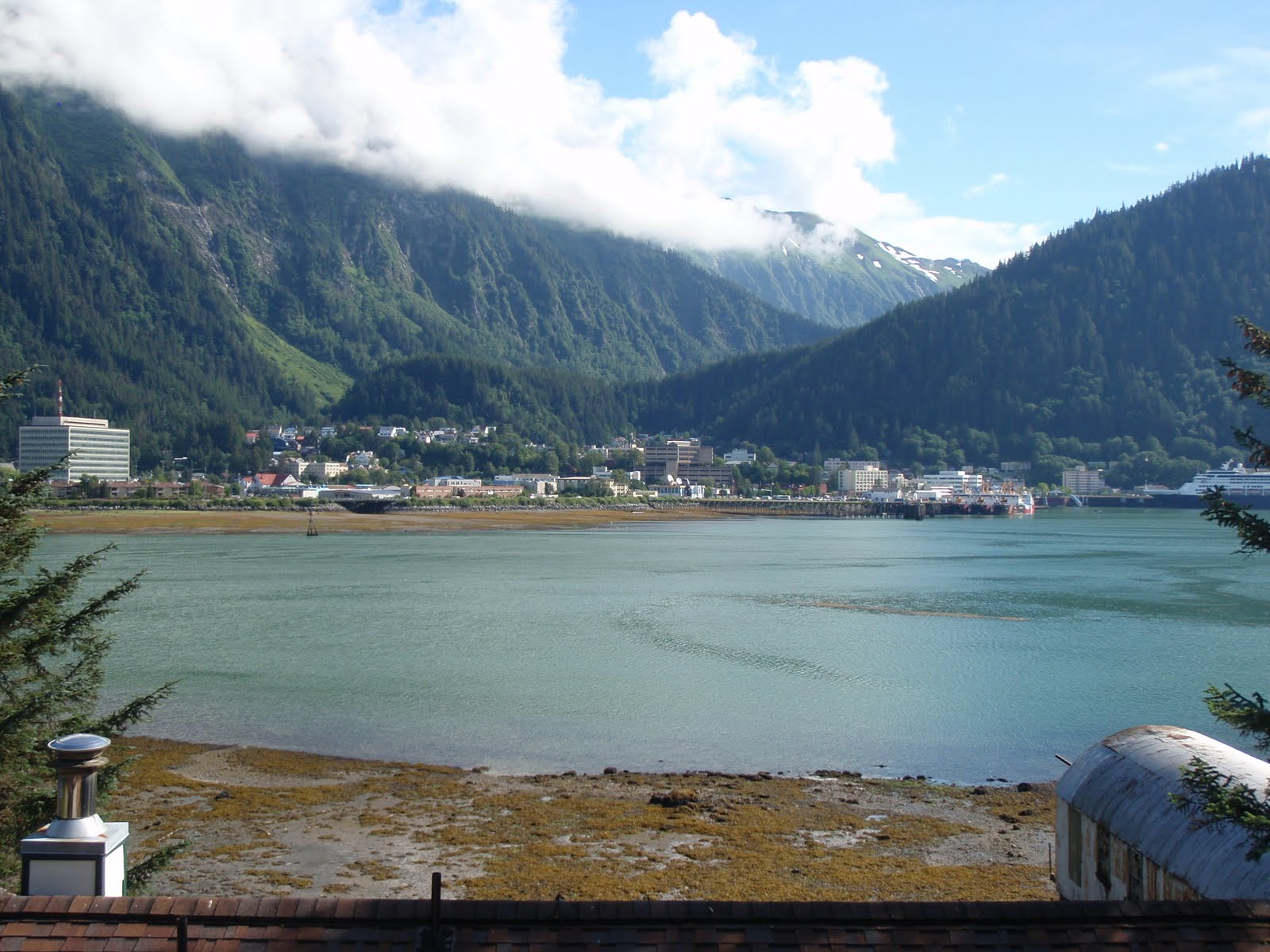
After the day we arrived, in lowering clouds, we had two rainy days in Juneau.  Not to worry: the first day was largely given over to boat chores and shopping – we have a long stretch in Glacier Bay coming up, including the arrival of David and Lucas for a few days.  Crankcase oil and filters were changed, bags and bags of groceries were loaded on, and halibut “Haliburgers” at Hotbites at the head of the wharf needed to be eaten.  More of the same the following day, except that it was time to do something more strenuous.  So Jess, Frank and I headed up the Roberts Mountain trail, a popular hike for Juneau folk, which ends up at the top of the tramway that starts down at the cruise ship dock.  There is a Nepalese saying: “ratto, batto, chiplo matto”, roughly translated as “red mud slippery trail”.  This was an understatement – the trail was steep, very muddy, and impossible not to slide on. Besides, it was raining and foggy.  So we saw nothing but thick forest and a lot of mud, and managed to get a lot of the latter on ourselves.  But it was a good workout, and we all met up at the top, where there is a nice restaurant, for some hot cider and a view of the resident eagle.  In the evening we wandered around Juneau, seeing the sights and the tourist bars, and had a good Mexican dinner.


Downtown Juneau


In the marina, we had a chance to talk to some of the locals who make their living from the sea here.  A crab fisherman (a Middlebury grad) told us how he’d wandered around after college, fishing sometimes with friends in Alaska during the summer.  Then he fished one winter, met a girl in Juneau, and that was that.  At the dock, his boat was full of 5,000 pounds of Dungeness crabs waiting to be unloaded and shipped to Portland, Oregon by air, to be distributed from there.  He has two kids in college, and his wife has gone back to work, of necessity.  The long-liners were getting ready for a new salmon season opening:  there are multitudes of seasons here, allocated to various areas, which seldom last for more than two days, during which you can catch as much as you can.  As a rule, these folks can fish for two or three days, and then come back to port for two or three before heading out on a new “season”, all dictated by the government.

Things improved dramatically in the morning, with the sun largely present, and the mountains and glaciers shimmering around us.  So we headed back to the Mendenhall Glacier, and hiked the 3.5 mile East Glacier Loop trail, up hill and down dale, through ever changing vegetation depending on when in the geological cycle the glacier had last been there.  Then it was time to refuel and head on out, with a langourous  sail in the sun down the Lynn Canal to the small inlet known as Funter Bay, in a glorious sunset with fish jumping all over the place and a school of Dall Porpoises playing in our bow wave.  We’ve been fishing, too, in a thoroughly disorganized and unschooled manner.  Nothing caught yet.  It is more likely that some stupid fish will jump into our dinghy than be caught on our hook.  A phone call to Frank Kibbe for advice was instructive:  I’m too impatient and trolling too fast.  What else is new..


The road to Glacier Bay from Funter Bay is the Icy Strait, which comes by its name honestly.  But for us it was a romp.  We sailed out of Funter Bay in a brisk Northwester, and beat our way up to Hoonah in a rising sea.  Hoonah is the largest Tlingit settlement left in Alaska.  It is there, on the south side of the Icy Strait, because several hundred years ago, at the inevitable onslaught of the little Ice Age in Alaska, the Tlinget settlement in what is now Gustavus and Bartlett Cove (Glacier Bay) was ground down under the advancing ice.  The village elders had the good sense to head south.  When Vancouver first sailed there in 1790 and made his seminal charts, he showed the whole of what is now Glacier Bay as “ice field”.  That was what Muir expected when he first arrived in 1879, but by then the ice had receded some twenty five miles or so.  In any event, Hoonah is now a town of perhaps 500 souls, subsisting mostly on fishing and logging.  But, probably again due to some substantial pork, there is a large marina facility, filled with fish boats and a few of us, surrounded by a huge stone breakwater.  An ancient Tlingit burial ground, with old totems, marks the entrance on a small island.  In addition, the town boasts an Olympic size swimming pool in its own separate building.  The shower in the harbormaster’s office was nice, but the timer on the hot water wasn’t working too well.  I was full of soap and shampoo when the water went off.  What to do?  I wrapped my town around me, ran around through the building looking for the harbormaster, and when I found him he unloaded enough quarters on me to finish the job.  Big laughs all around.
Icy Strait in the morning was a flat calm in glorious sunlight.  16,000’ Mt. Fairweather, which presides over the entire Glacier Bay area, was glistening in the sun along with its entire range.  Orca whales appeared as we powered along the 25 miles to Glacier Bay.  A huge swarm of sea lions and otters greeted us at the entrance buoy, and then we were in Bartlett Cove, where the check-in point and Ranger Station is.  Our plan was to check in, get the required boaters’ briefing, and then head up the bay a few miles in anticipation of a shopping, a cleaning, and a reception for Dave and Lucas at Bartlett Cove the next day.
The whales are the most abundant in Bartlett Cove in recent memory.  Some 30 of them swim, feed, and play in this small, active cove.  They blow, bellow, throw themselves up with mouths gaping open, sing, and fully mingle with the many boats coming and going.  Happy mixture!  We pulled away from the dock about three, amidst the whales around us.  Within two minutes there was an alarm sounding below, so I went below to find it.  It was the propane stove alarm, so I opened the hatch into the engine room and was greeted by billowing acrid smoke coming out of the hatch.  Although the engine dials read appropriately, the engine was making a lot of strange and nasty sounds.  First stop was the fire extinguisher, and the second was to turn around and head into the nearby anchorage.  In a minute or so I was sure that we could drift in, and so I shut the engine down and eventually we got the anchor down.  By now the boat was pretty well full of smoke.  But the nasty sounds had stopped, and the smoke seemed to be stabilizing.
Ranger Rachel was at the other end of my VHF call to the station on shore, and she just happened to know someone she could recommend as a mechanic i(Zack) in Gustavus.  Her car was in his shop right now.  It was Friday night at 5, so I called Zack, and after some discussion he graciously consented to drive over to the cove (25 minutes) and have a look.  He came aboard, sniffed a little, and said it smelled like a starter problem to him.  JACA’s starter is on the wrong side of the engine – one needs to be a contortionist (in the bilge) to reach it.  Zack started working on inaccessible engines in his father’s fishing boat, and at age twelve was the one appointed to crawl around in the tightest spaces and fix things.  JACA’s starter had indeed fried itself, and in the process had burned out a large wire, a rubber covering, and some adjacent wires.  But the beauty of the whole thing was that JACA had a spare starter on board.  So Zack went to work, and in less than two hours the old starter was off, the new one was on, and we were all sitting in the cockpit having a beer.  In the process we got Zack’s full life story, which one could write a steamy novel about.  But he was a gem, and when I told him he’d gone beyond the call of duty he said it gave him real pleasure to help out folks like us who had a family on a boat visiting Glacier Bay.
Gustavus is the town with the airport serving the Glacier Bay National Park whose entrance is about 10 miles away.  In winter, 350 people live in Gustavus.  In summer, a few more.  The town itself is spread out over a surprisingly large area.  There are a couple of small grocery/miscellany shops, a few B & B’s, the most notable of which is The Gustavus Inn which serves a very good, expensive dinner as well, and a good pizza joint.  Pam did a reasonable shopping here, but it is quite basic.  We needed a couple of additional coffee mugs for the boat, and none were to be had in any shop.  So I was directed to the “community chest” thrift store, which was a small house-like event close to the airport.  There were plenty of cracked and scratched mugs, including a few plastic ones from the Glacier Bay Lodge.  So I picked out several and asked the lady what the bill would be: 35 cents.  It is a friendly place too – when you walk down the road every car driver automatically waves to you, and if you hang out your thumb you are immediately picked up.
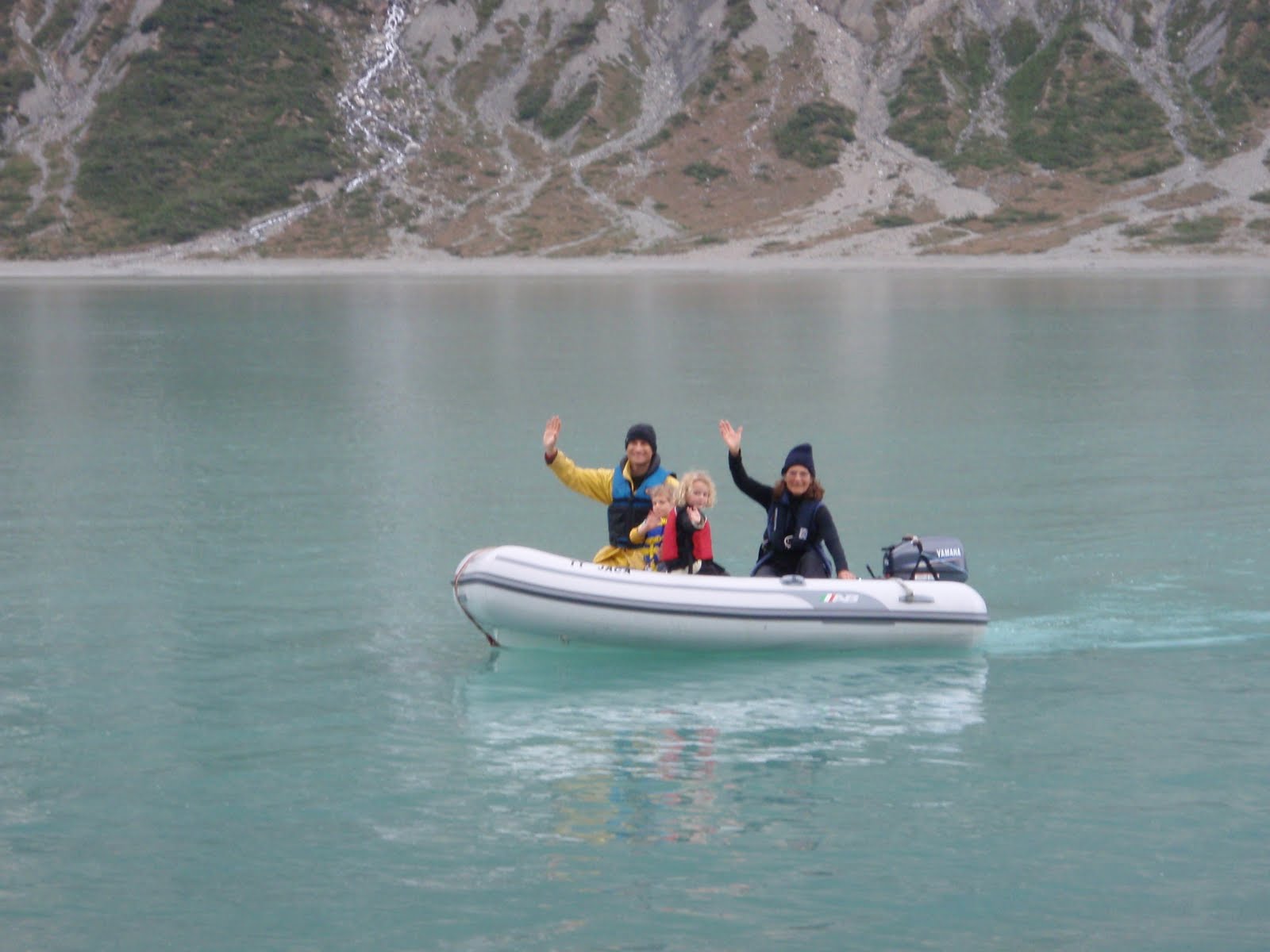
Late in the day the plane from Juneau arrived, and David and Lucas stepped off into a gorgeous Alaska afternoon.  Their flight had been spectacular, of course, and the addition of whales and porpoises playing in the harbor was icing on the cake for them.  It was a great reunion on what was now a pretty cramped boat.  No matter, for the family is now almost all together for a brief few days in Glacier Bay.  I wonder if JACA has ever played host to two five-year olds before.  They are having a grand time playing all over the boat, while Pam does triple duty as the sought-after Nana, the baker of all manner of treats with the kids, and first mate.
Our good luck on the weather ran out the next morning.  We headed out early, to catch the last of the incoming tide in fog and rain, stopping for lunch at Blue Mouse Cove and heading onward to Reid Inlet for the night.  The weather was a little better there and when we turned the corner into the harbor, Reid Glacier was shining blue and beautiful right at us, even in the clouds and mist at the peaks.  The first order of business was to go ashore and touch it – this is one of the few glaciers that terminates at the water’s edge but does not calve off into the water.  While all glaciers move forward (they are getting new snow all the time), the rate of melting now exceeds the rate of advance, and Reid has retreated to the shore line, making it accessible to approach without danger of being crushed or tipped over by a wave.  The terrain around it is moon-like, representing the earliest stages of life after the glacier leaves.  Basically it looks like a gravel pit abandoned by bulldozers after a few half-hearted tries to smooth things out.  No signs of life, a few rushing streams with dirty water pouring out from underneath the glacier, and vast quantities of mud and silt covering everything.  After a little while, a few flowers begin to pop out and bloom.  Then some hardy grasses and mosses, and finally the shrubbery starts to appear after a few years.  The whole “succession” of rebirth after the glacier leaves is laid in front of you at Reid – as Jessica put it, it is a crash course in the global warming process.


In the morning we headed to a highlight of Glacier Bay:  the John’s Hopkins Glacier (via the smaller but thoroughly enjoyable Lamplugh Glacier along the way), about a dozen miles distant.  We got within about two miles of it before deciding we weren’t going push JACA through the ever thickening ice any more.  On the ice all around us were hundreds of seal pups – they are born on the ice and spend their first few months there.  The glacier rose majestically in front of us, and we could hear it creaking, groaning and occasionally calving off small pieces.  The pictures you see of JACA at the glacier were taken by another boat that followed us in and eventually passed us.  We traded pictures back at Reid Inlet the next morning!  By now the weather was deteriorating quickly, and while we wanted to complete the day with a run up to the Marjorie and Grand Pacific Glaciers visited each day by two huge cruise ships, the ice and fog discouraged us and we headed back to Reid Inlet for more glacier exploring there.  The weather was in fact worse in the morning, so those two must wait for another cruise.  We headed out to another part of the park, radar running full bore and cruise ships honking in the main channel.


The evening found us in Tidal Inlet, a long indentation with large avalanche-strewn slopes on one side, and lower green areas on the other, sprouting waterfalls every few yards.  It was calm and misty, so we picked a likely spot and dropped the anchor in nearly 100 ft of water a few yards from the shore, then unrolled the spool of stern line in the after part of the cockpit and took it around a tree and back.  JACA’s stern, in 35 feet or so of water, was a few feet from the shore, and we were snug as a bug.  The kayak went off exploring, and we fell asleep to the sounds of the waterfalls. 


No better weather in the morning, but we headed up the twenty-five mile long Muir Inlet to explore some more glaciers.  When Muir established a summer base camp at the entrance to the Inlet in the 1880’s, that’s where the glaciers started.  Since Vancouver’s time, the glaciers here have receded faster than any others in recorded history.  I wonder what our grandchildren will see fifty years from now…
The rain came and went, the fog came and went, and the clouds sometimes lifted a little to let us see the enormous peaks all around us.  A late lunch at the Riggs Glacier, followed by dinghy explorations into the McBride Glacier, completed our education in glaciers in Glacier Bay.  At Riggs, we reached the northernmost point of this trip: Latitude 59 degrees 4 minutes north, which is as far north as I’ve ever been in command of a boat.  It was worth a beer!
On the way into the McBride Inlet, which can now be done only by dinghy, a forlorn group of kayakers trying to establish camp on the inlet’s beach waved to us – it was pouring cold rain, and the water temperature was a balmy 33 degrees.  While the scenery was great, we were happy to know that we could retreat to the warmth of JACA’s dry cabin!  That night we retreated also, to the entrance of the Muir Inlet in quiet North Sandy Cove, a favorite of campers and boaters alike. It had recently been closed to the campers because of bears.  Sure enough, even before we got our anchor down there was a big black bear on shore to greet us.
With slightly better weather in the morning, we meandered our way back to Bartlett Cove.  First stop was South Marble Island, which is off limits for landing, and we soon learned why.  As we drew closer, great roaring sounds came from herds of sea lions living there.  So we shut off the motor, pulled out the jib in the faint breeze, and slowly drifted by.  A chorus of sea lions is somewhat similar to a truly awful mens’ singing chorus.  Loud fart-like barking is accompanied by a background of general moaning and groaning, producing a loud dissonant buzz that might come from a monastery of very sick monks.  Meanwhile these large creatures flop about on the rocks, and occasionally fall into the ocean with great splashes as if someone had thrown them into the swimming pool.  While watching all this, a couple of humpbacks surfaced next to us, unconcerned about anything but working on lunch.

Today (Friday July 29) has been the day to say farewell to Jessica, Frank, Zia, David and Lucas, which wasn’t easy.  Two active five-year olds on a sailboat isn’t easy on either us or them, but they behaved beautifully most of the time, much more than could be expected.  Some of this was due to Pam’s and their parents’ valiant and unflagging efforts to keep them entertained in the cabin when the weather wouldn’t let anything else happen.  We also read a lot out loud, with repeats of classics such as Charlotte’s Web and Charlie and the Chocolate Factory, and endless replaying of a performance of Peter and the Wolf I did with the symphony two decades ago.  But a lot of it was their inherent good nature, happiness to have a chance to play a lot with each other, and willingness to try something new every day.  It was a rare and wonderful family experience, and we’re very happy that it could happen.


We will leave Glacier Bay tomorrow, bound for Sitka.  It will be a much quieter and calmer boat.  Veteran crew member Joel Tranum has joined us.  Just before he arrived (with some good steaks from Wellesley!), a bunch of southerners came in on their little sport fishing boat.  They had been out fishing for halibut, as they do for three weeks a year here.  Today they had caught a lot, keeping only ten, the largest of which weighed 100 pounds.  All were neatly filleted and were headed for the local freezer to be prepared for shipment home with them.  They happily gave us a huge fillet – enough for at least two meals.  When they leave next week, they will be accompanied by their catch of about 3000 pounds of frozen halibut fillets in 50 pound boxes, destined for the freezers of family and friends in North Carolina.  Next summer they’ll be back for more.  And so it goes in Alaska.

Monday, July 18, 2011

Post # 5 Posted at Juneau, AK, July 18, 2011

JACA Blog entry # 5    Petersburg to Juneau.
This entry begins at Petersburg, where we arrived on Saturday July 9.  After a day of chores, in gorgeous weather, we went out to dinner at the Beach Comber Inn, a few miles done the road, driven by a courtesy van.  There we had one of the fish dinners we’ve ever had anywhere:  I had a “White King Salmon”, which is a king salmon whose flesh is white, and Pam had a smoked black cod.  We don’t have fish like this on the East coast, so it was a special treat.
The next day was also beautiful, with the great snow-capped range looming across Frederick Sound, which borders Petersburg, shining brightly.  We took a long hike around the town and its outskirts, and concluded that this is a very different place than the others we have visited so far in Alaska.  Perhaps it is because the population is 70% of Norwegian descent and 20% of Swedish descent.  In any event, it is clean, friendly and while there isn’t much tourism amidst all the fishing, it has the air of a place accustomed to living unpretentiously well and enjoying life in a beautiful setting.  There is no question, however, that this place is dedicated to fishing: the fish boats come and go at all hours of the day and night, and the crews are the most common passers-by on the streets.  In the marina, whole families come and go to work in the fleet, and little children run up and down the docks to visit fathers and mothers coming and going on the boats.  There are bunkhouses provided for the workers in the canneries and processing plants – they come from all over the world, it appears, and stay for one fishing season or the other.  The processing plants run 24/7. 

When we arrived, we tied up beside a traditional Alaska fishing boat, whose owner showed up just at that moment.  He was a man who looked to be about 70, and moved about his boat with great deliberation, packing away some food and getting things ready.  He had the air and speech of a retired English professor.  We asked him if he was headed out, and he said yes.  Did he have a crew?  No, he fished alone-even though he was pretty old he still loved to be out there fishing.  How long would he be out?  Until mid-September.  Where did he fish?  Off the Dixon entrance, near the Canadian Border, in a notoriously rough part of the world.  He turned on his motor and backed out of his slip and was gone.  We asked the harbormaster about him, and were told he was a wealthy man who never needed to catch another fish.  We wished we’d had more time to talk to him!


Early in the evening we welcomed Jess, Frank and Zia arriving on the ferry from Bellingham.  After dinner, however, Jess got violently ill and had an awful night.  In the morning Frank decided that she should go to the local hospital because she was so dehydrated.  I called a cab and told him that we’d need first to go the hospital and collect a wheel chair for her, since the boat was a long ways out in the marina, and then we’d come back to the dock and get Jess and take her to the hospital.  He said fine, but took a little while to show up.  When he did, he’d already gone to the hospital on his own and collected a wheel chair.  When we got Jess to the hospital, he wouldn’t take any fare, saying it was the least he could do to help out a sick lady.  Once in the ER, Jess was beautifully treated, checked over, rehydrated, and ready to head off with us within a few hours.
Which is what we did.  Late in the afternoon we headed across Frederick Sound to Thomas Bay, home of the Baird Glacier and a host of other glacial streams coming down from the mountains.  As we got into the bay, the water temperature dropped from about 50 degrees to about 38 degrees in a matter of minutes, and the color of the water turned to glacial green.  We anchored in the usual deep water and went ashore to find the ranger cabin and trail head to the waterfall and lake above.  On the stony beach, a couple of guys were cleaning a huge halibut they had just caught.  They were renting the ranger cabin for the week, and were spending their days fishing from a small outboard.  We admired the halibut, and were promptly presented with enough fresh fish to last a week!
Our glorious weather continued unabated for four days before reverting somewhat to the norm, and then it got better again.  Summer has come to Southeast Alaska, if only briefly.  I’ve been swimming – first in 48 degrees, and then in a balmy 54.  It doesn’t last long, but we’ve got the pictures to prove it.  No company in that activity yet, but the sunscreen has been in use for the first time here.  We all did a long, arduous hike up the Cascade Creek trail in Thomas Bay.  By any rating this was a “most difficult”, and 5-year old Zia clambered along with the rest of us, most of the time refusing any help at all.  It was about the muddiest, slipperiest steep hike we’ve done in a long time.  But the roaring cascade near us was awesome.  That hike necessitated the first swim.  The second was a balmy afternoon at anchor in Cannery Cove (Pybus Bay), looking over a serene estuary, drinking a beer and waiting for some bears to show up.  The mountains are definitely getting bigger, and shimmer white all day and into the night in the sun.
It’s been a joy watching Zia adapt to life on a boat.  She’s game for anything, even participating in the daily crankcase oil check.  She now has her own daily job, sweeping out the cockpit.  We’ve rigged a trapeze on the foredeck to let her work off some of her enormous energy.

A major highlight of an otherwise long windless day under power was sitting still in a pod of feeding humpbacks in the middle of Frederick Sound.  We came upon them, and shut the motor down.  Some came within 50 feet or so of the boat, seemingly unconcerned with us.  They blew and snorted, lifted their tails repeatedly, and sometimes even showed us their long snouts and gnarly faces.  These largest beings on earth are endlessly fascinating.


The highlight of the ride from Petersburg to Juneau has been a long day exploring Tracy Arm and it’s two major glaciers descending into the ocean.  We entered Tracy arm late in the afternoon, under power in thick fog and an adverse 4 knot current.  It is a narrow opening between two buoys, and JACA was making very slow going of it in the wild swirls and whirlpools of the rushing
 water.  We’d already seen a number of small icebergs in the area, and several appeared out of the fog.  We made our way slowly to Tracy Arm Cove, which is the only decent anchorage in the area, and a good jumping off point to explore the long deep arms of the fiord.  A huge white motor yacht appeared out of the fog behind us, and followed us in.  There were already about 6 boats anchored there, so it seemed very crowded!
In the morning the fog was still thick but we were hopeful.  We headed out into the horns of a couple of cruise ships that had already made a pass up the fiord (what on earth did those folks see?), but as we worked our way along, the fog lifted, the mist began to part, and the sun starting peeking through.  By the time we worked our way through the increasingly thick ice to the first glacier (it takes three hours to do that in JACA), it was a beautiful day, and we sat in front of the wall of the Sawyer glacier drinking in this massive river of ice slowly tumbling into the ocean.  Every now and then a piece would fall off, sounding like a cannon shot and creating a huge splash even though the piece itself seemed very small.  Just another iceberg to start down the fiord!


Then we headed over to the South Sawyer glacier, which if anything is more majestic and stupendous than the Sawyer itself.  We found a decent hole in the crush of small ice bergs about ½ mile from the face of the glacier, and left Pam and Zia making circles in JACA while the rest of us jumped in the dinghy to take pictures, and get a little closer.  We got back to Tracy Arm Cove late but exhilarated: it had been one of those days you never forget.  In the cove, a bunch of small icebergs about the size of cars were milling about.  So we icepicked some hunks of ice for the libations, and watched the little bergs meander around the harbor.  All of them ultimately wound up on the shore, stranded for the remainder of their melting lives.

Slowly working our way to Juneau, we put in at Taku Harbor, about 25 miles south of the town.  This is a nicely protected place, the site of an abandoned cannery and a few fishing cabins.  The harbor authority of Juneau also maintains a nice public dock, which on a Saturday night turned out to be very popular.  We tied up there, among a couple of small fishing boats and a couple of sailboats out for the day from Juneau.  As the evening wore on, the fleet grew bigger, so by the end we were all rafted several deep.  We’d made the acquaintance of an elderly couple (he’s 73) on their small old wooden gill netter, a typical Alaska fish boat.  Irene wanted to know what a sailboat looked like down below –she’d never been on a one.  So she got the tour, and shortly thereafter produced a big hunk of king salmon, saying that they’d been eating enough fish.  And we got a tour of the little boat – cozy, Spartan, and warm.  Larry has fished his whole life.  Now he and his wife leave home in Prince of Wales Island in May, fish all summer, and go back in October for the winter.  Every day the “supply boat” makes the rounds of the fleet in the area, bringing ice for their tanks, and buying their catch.  Larry showed me his “slips” for the last few days of fishing.  He had several days of 3800 pounds in the catch, for which he was paid an average of $1 per pound.  He and his wife do it all alone.
Meanwhile, more fish boats kept arriving, and it soon became apparent that fishing in the summer in this part of Alaska is a family affair.  Behind us was Dan, on his 45’ gill netter.  With him for the summer were his 40 year old daughter, and her 7 year old daughter, Kennedy.  Rafted along side him on a slightly smaller boat was his son-in-law (married to his daughter) and their other child, a five year old boy, plus another brother from New Hampshire.  The young family lives and works in Colorado in the winter.   She’s a special-ed teacher.  Then Dan’s son showed up on a third boat with his family aboard.  This is very different than fishing in Maine, and is a pleasure to see.  There were multiple tours of JACA and vice versa.  The kids work too: Kennedy catches the fish coming down the chute from the net as it reels in and stuffs them in the hold!  Amid great hilarity from the multitude on the dock, three of the youngsters, including the 7 and 5 year olds, were tossed into the 50 degree water and immediately fished out.  Noisy firecrackers followed.  They were all off the dock early in the a.m.
Zia and Jess had another wish fulfilled: in Taku we saw our first black bears, a mother and two cubs, foraging in the bushes near the shore while we sat quietly in the dinghy watching the show!
Yesterday morning, Sunday July 17, we headed out of Taku towards Juneau, in a sunny placid sea.  We discovered early on that the (only) head wasn’t working properly, in that it wouldn’t take in water for flushing.  Serious problem on a boat!  So I found the manual for the thing, and then began disassembling the intake side of the operation.  Sure enough, after a while, a piece of lettuce dropped out of the inner valve, and after reassembly we were good to go.  Alaska waters are full of all sorts of stuff, but what a relief!
Now we are moored in Auke Bay marina, about 11 miles north of Juneau, which is the only reasonable place for boats like us to go.  We’ve already rented a car and had a first quick trip to the Mendenhall Glacier, which dominates Juneau, and a great fish/crab dinner downtown.  At the outer edge of the marina are two huge fish boats, both from Seattle, named the Dominator and the Gladiator respectively.  Their noisy generators grumble throughout the whole marina.  Tomorrow it is going to rain all day, so the chores and shopping will begin.  JACA has been 1060 miles since Bella Bella, and we have reached the half way point, time wise.  We are above latitude 58 north, which is nearly 400 miles further north than our northernmost point in the Newfoundland trip.  I can only hope the next half will be as grand as the first!  The status of the facial hair is shown in the last picture.